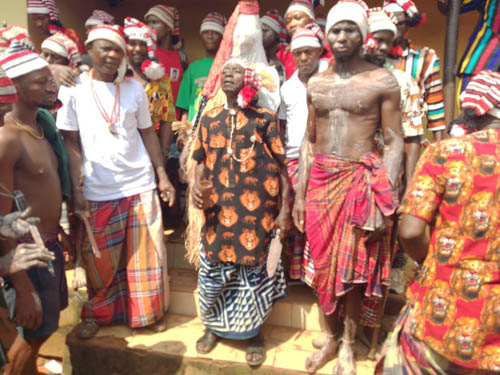
These patriarchs were primarily hunters who occupied separate forest territories, each surrounded by family
homesteads and farmlands. Over time, they discovered one another and formed a united community.
Each kindred had a distinct settlement area and deity associated with it:
1. Ama-Elu: Settlement linked to Atitakpo, progenitor of Abam Onyerubi.
2. Onu-Nta-Ikpo: Settled at Nde-Onu, where the Onu deity was discovered.
3. Uka Abam: Near Ogo Ndi-a-Uka and Onu-Achi, the village square of Umu-Uka.
4. Eji-Eji: Associated with Achichi Amaeke and later Ojiugwo deity.
5. Nkwo-Mkpu: Linked to Ndi-a-Nkwo forest and Imo-Ohuma deity.
6. Ottai: Possibly migrated from present-day Cross River State, settling near Itim forest and
Uda-Mini-Ufuforo deity.
7. Nsama Anyaji: Connected to Iyi-Ndi-a-Nsama stream.
8. Ubiom: Lived at Ebem-Iyi, home of the Idogo deity.
Two kindreds—Ubiom and Nsama Anyaji—are historically associated with the Ama-Etiti area, while the others
are linked to Ndi-Uka.
The unity of the eight kindreds gave rise to Ebele Ozu, the ancestral meeting ground and spiritual heart of
Ozu Abam. Ebele Ozu served as:
1. A political center for decision-making.
2. A spiritual headquarters where critical matters are settled
3. A war council ground.
4. A symbol of unity.
From as early as the 18th century, Ebele Ozu was recognized across Abam as the place where matters of war,
peace, and governance were resolved.
Abam people were historically renowned warriors. Their military strength led neighboring communities,
particularly Arochukwu, to engage them in mercenary campaigns, especially for debt enforcement. Notable wars
traditionally associated with Abam planning from Ebele Ozu include:
Ubegu War
Uturu War
Izuogu War
Ngwa War
Ugep War
Ezi-Nnachi War
These campaigns enhanced Abam’s reputation for courage, discipline, and strategic unity.
After the establishment of the Ozu confederacy, other groups became part of the community:
a. Ama Izu Kindred
Founded by Izu Ama, this group emerged following internal migrations after the death of Atitakpo. Historical
consensus holds that Ama Izu joined Ozu after the original confederacy and did not participate fully in
early Oso Ozu obligations.
b. Amangwu Kindred
Amangwu traces its origin to Ama, a medicine vendor from Item who introduced the powerful Ngwu deity. Ama
was appointed priest and settled near the shrine, leading to the formation of Ama-Ngwu. Though not part of
the original eight, Amangwu became culturally significant, especially in the Ochi-Chi festival.
c. Ipia-Nta-Uma Kindred
Ipia-Nta-Uma are regarded as the earliest inhabitants of the land. Oral tradition describes them as
reclusive and distinct, which contributed to their exclusion from the original Ozu covenant, despite their
early presence.
Participation in the Oso Ozu Festival is traditionally regarded as a defining mark of original membership in
the Ozu confederacy. The festival symbolizes unity, ancestral remembrance, and communal identity. Other
festivals, such as Ochi-Chi, also play important roles in Ozu cultural life.
Ozu Abam is a peaceful and hospitable community blessed with fertile land and hardworking people. The
community is known for the cultivation of:
Oil palm
Cocoa
Kola nuts
Plantain
Yam
Cassava
The people of Ozu Abam are industrious, forward-looking, and deeply rooted in their cultural heritage.
Ozu Abam stands as a living testimony to unity in diversity. Born not from bloodline but from consensus,
cooperation, and shared destiny, Ozu remains a powerful symbol of communal strength, cultural resilience,
and historical continuity.